DePIN: The Evolution of GPU Mining and How to Profit from Decentralized Physical Infrastructure in 2026
With DePIN, mining game has changed. Traditional Proof of Work mining—once the reliable money printer for anyone with decent hardware—now works against small operators in ways that are hard to ignore. Bitcoin’s 2024 halving cut block rewards in half, and the next one around 2028 will drop rewards to just 1.5625 BTC per block.
But something interesting happened while PoW mining got harder. AI exploded, blockchains got more sophisticated, and a new category emerged at the intersection. Decentralized Physical Infrastructure Networks, or DePIN, offer GPU owners a different way to generate income—one that might actually make sense long-term. If you’ve been wondering whether DePIN is worth your attention in 2026, here’s what you need to know.
Why Traditional PoW Mining Is Losing Ground
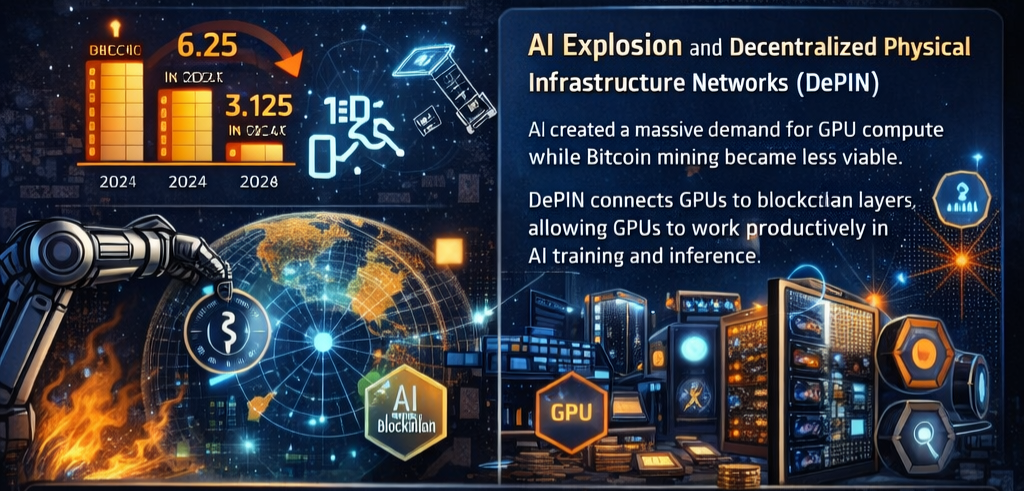
The economics have gotten brutal for individual miners. Network difficulty keeps climbing, electricity costs keep rising, and block rewards keep shrinking. It’s a squeeze from every direction.
The math just doesn’t work for most home miners anymore. When Bitcoin’s block reward dropped to 3.125 BTC in April 2024, miners felt it immediately. The survivors adapted—cutting costs, upgrading to more efficient hardware, or chasing transaction fees to make up the difference.
But there’s another path. AI has created massive demand for GPU compute power, and the big cloud providers—AWS, Google Cloud, Azure—can’t keep up. That shortage created an opening.
DePIN platforms let GPU owners rent out their hardware for AI training and inference work. Instead of solving cryptographic puzzles for diminishing returns, your graphics cards do actual productive work that companies will pay for directly.
What Is DePIN and Why Does It Matter?
DePIN connects physical infrastructure—GPUs, storage devices, wireless equipment—to blockchain coordination layers. Anyone can participate, and compensation happens transparently on-chain.
Traditional mining turns electricity into hash power that secures blockchain networks. DePIN turns that same electricity into compute cycles that train AI models, render graphics, or crunch complex calculations. The difference is in what you’re producing: hash power has no use beyond network security, while AI compute has immediate commercial value.
This matters for sustainability. As regulators scrutinize energy-intensive PoW mining, DePIN sits in a more defensible position. You’re not burning electricity on arbitrary puzzles—you’re providing infrastructure for the AI economy.
The sector has grown up since its experimental early days. The leading DePIN projects in 2026 have moved from speculation to actual infrastructure serving real enterprise customers. That shift from hype to utility marks a turning point. Learn the transformation from GPU-to-AI Mining and it’s profitability.
DePin Earning Potential: What Can You Actually Make?
The numbers are worth examining. High-end NVIDIA GPUs can generate $300-$800 per month in rental income, depending on specs, utilization, and which platform you choose.
An NVIDIA RTX 4090 offers excellent compute density for AI workloads. Connected to legitimate rental platforms, this card can earn $400-$800 monthly when demand is high. Passive income from a 4090 setup is realistic for operators who know what they’re doing.
But let’s be honest about the caveats. Earnings fluctuate with network demand, competition from other providers, and the specific tasks your hardware handles. Training large language models pays better than simple inference. Rendering 3D scenes pays differently than running scientific simulations. Nothing is guaranteed.
Hardware requirements for viable participation:
- NVIDIA RTX 30/40/50 series cards with at least 8GB VRAM (16GB or more gives you a real edge)
- Stable fiber internet that can handle sustained high-bandwidth transfers around the clock
- Reliable cooling, because continuous compute loads generate serious heat
- Uninterruptible power supply to prevent job failures during brief outages (these hurt your reputation score)
If you’ve run mining rigs before, the barrier to entry is low. Your existing hardware, power setup, and cooling solutions transfer directly to DePIN operations.
DePin Platforms Deep Dives: Where to Put Your Hardware
Not every DePIN platforms out there deserves your attention. The space has legitimate infrastructure projects and questionable ventures designed to extract value from participants. Knowing the difference matters.
io.net
io.net is a Solana-based platform built specifically for AI and machine learning cluster aggregation. It connects distributed GPUs into unified compute clusters capable of handling enterprise-scale AI workloads.
The aggregation focus is what makes it interesting. Individual GPUs become part of larger virtual clusters, enabling tasks that would otherwise require expensive centralized data centers. Whether io.net is legitimate comes down to verifiable compute utilization and transparent payouts—and so far, the evidence supports it.
The platform pays providers in a mix of its native token and stablecoins, which offers some protection against token volatility. Enterprise customers include AI research labs, startups training custom models, and companies running inference at scale.
Render Network
Render Network (RNDR) started in GPU rendering and has evolved into a general-purpose AI compute platform. That transition shows how flexible decentralized compute infrastructure can be.
Originally built for 3D artists and animation studios needing rendering power, Render saw the broader opportunity in AI compute. The platform now handles diverse workloads—model training, inference, and traditional rendering.
RNDR’s token economics have matured with its use cases. The network has processed millions of rendering jobs and increasingly handles AI-specific work from legitimate enterprise customers.
Aethir
Aethir targets enterprise-grade GPU distribution with institutional-level infrastructure standards. This means customers who need reliability guarantees that consumer-grade operations can’t provide.
The platform prioritizes quality over quantity in its provider network. Hardware requirements are stricter, uptime expectations are higher, and compensation reflects those elevated standards. If you’re willing to invest in a professional-grade setup, Aethir offers premium earning potential.
Akash Network
Akash is a decentralized cloud marketplace extending beyond GPUs to general compute, storage, and hosting. It operates as an open-source alternative to centralized cloud providers.
The marketplace model lets providers set their own prices, creating competitive dynamics that benefit both sides. Akash has gained traction among developers looking for cost-effective alternatives to AWS and similar services.
How to Spot Legitimate DePIN Platforms
The DePIN space has its share of questionable projects. Separating legitimate platforms from schemes requires looking at several things systematically.
Actual Compute Utilization
Legitimate platforms can show that real compute work happens on their networks. That means verifiable job logs, transparent utilization metrics, and evidence that enterprise customers actually use the infrastructure.
Watch out for platforms claiming earnings without explaining what work generates those earnings. If a project can’t tell you who pays for compute and why, be very cautious. Real infrastructure serves real customers with real budgets.
Transparent Payouts
Platforms paying primarily in volatile proprietary tokens create concerning dynamics—your earnings depend on token price appreciation rather than actual service value.
Look for stablecoin payment options or hybrid models with stable components. This transparency suggests the platform generates real revenue from customers rather than relying on token inflation to pay providers.
Genuine Community Activity
Legitimate projects have active communities of real operators sharing experiences, troubleshooting problems, and discussing optimizations. You can find these on Discord, Telegram, and forums where actual humans run actual hardware.
Be skeptical of communities dominated by promotional content, bot activity, or suspicious enthusiasm without substantive technical discussion. Real operators complain about problems, ask questions, and share genuine experiences—good and bad.
Specific Hardware Requirements
Serious platforms specify exactly what hardware qualifies and why. Vague requirements or claims that any hardware can earn significant income suggest the platform isn’t matching providers with real workloads.
Legitimate AI compute requires specific GPU architectures, VRAM quantities, and connectivity specs. Platforms ignoring these realities probably aren’t running real AI workloads.
Setting Up Your First AI Mine
Moving from traditional mining to DePIN requires some adjustments, but your fundamental infrastructure translates well. Existing power, cooling, and networking investments provide a solid foundation.
Hardware
Start with your highest-spec GPUs. NVIDIA’s RTX 40 series cards offer the best balance of compute performance and power efficiency for AI workloads. The RTX 4090 is the consumer flagship, while RTX 4080 and 4070 Ti cards deliver strong performance at lower prices.
VRAM matters a lot for AI workloads. Cards with 16GB or more can handle larger models and more complex tasks, commanding premium rates. The 8GB minimum is a floor, not a target.
Networking
AI compute demands better networking than typical mining. Mining only transmits small amounts of data; AI workloads involve transferring large datasets and model weights.
Get fiber connectivity with symmetric upload and download speeds. Gigabit connections are the minimum for serious participation. Consider dedicated business internet with uptime guarantees.
Software
Each platform provides specific software for connecting your hardware to their network—typically containerized environments, monitoring dashboards, and automated job management.
Get comfortable with Linux if you aren’t already. Most DePIN platforms prefer Ubuntu or similar distributions for stability and compatibility with AI frameworks.
Monitoring
Continuous monitoring ensures maximum uptime and catches problems early. Set up alerts for temperature spikes, job failures, and connectivity issues. Your reputation score on most platforms depends on reliability.
Remote management solutions let you restart services, update software, and troubleshoot without physical access to your hardware.
The Regulatory Angle
DePIN tells a fundamentally different story than traditional PoW mining when regulators come asking questions. This distinction may matter a lot as governments worldwide pay more attention to cryptocurrency’s environmental impact.
Traditional mining converts electricity into network security through computational puzzles. Critics call this wasteful energy consumption for abstract value. Whether that criticism is fair or not, the political reality creates problems for mining operations.
DePIN converts the same electricity into productive compute work with clear commercial applications. Training AI models that improve healthcare, accelerate research, or enhance creative tools is tangible value that regulators and the public can understand.
This advantage extends to renewable energy. Mining operations can use renewable power, but DePIN platforms operations can make the same claim while pointing to productive output. The story shifts from “using clean energy for puzzles” to “using clean energy for AI.”
What’s Next
AI infrastructure demand, regulatory pressure on traditional mining, and maturing DePIN platforms have converged to create a real opportunity for GPU owners. 2026 looks like a turning point as the sector moves from early adoption to mainstream infrastructure.
Enterprise adoption keeps accelerating as companies look for alternatives to capacity-constrained centralized providers. AI demand shows no signs of slowing, and compute requirements for training and deploying models keep growing.
For former miners and hardware enthusiasts, DePIN is the natural evolution of GPU monetization. The skills, infrastructure, and operational knowledge translate directly. The economics have shifted toward productive compute over hash power.
Success requires careful platform selection, realistic expectations, and commitment to operational excellence. Those who approach DePIN with the same dedication they brought to mining will find sustainable opportunities here.
The migration is underway. The question isn’t whether DePIN will matter for GPU monetization—it’s whether you’ll be positioned to participate when enterprise demand peaks.